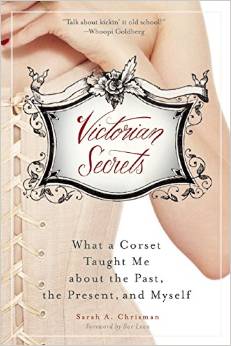
 A woman fascinated by vintage clothing who decides to start wearing a corset on a daily basis is a book subject that would naturally interest me. Rachel, my first-person narrator, travels to 1815 and starts wearing a corset (along the rest of the period-appropriate outfit), and I am curious about how that must have felt to her. (Though not enough to actually dress up like that.) Even if the author’s corset — the waist-squeezing, hourglass-figure-imposing kind adopted in the 1830s and worn for the better part of the next century — is different from the c. 1815 model, which left the waist largely as it was, there still must have been a sense of confinement and required uprightness alien to our elasticized age. What would that be like? What practical problems would the author encounter? So when I found a review copy lying around the office, it vaulted to the top of my to be read pile.
“Victorian Secrets” by Sarah A. Chrisman was fascinating, although not in the way I expected and probably not in the way its author intended. Continue reading →
0.000000
0.000000





 The Jane Austen Project: A Novel