Reading and Writing

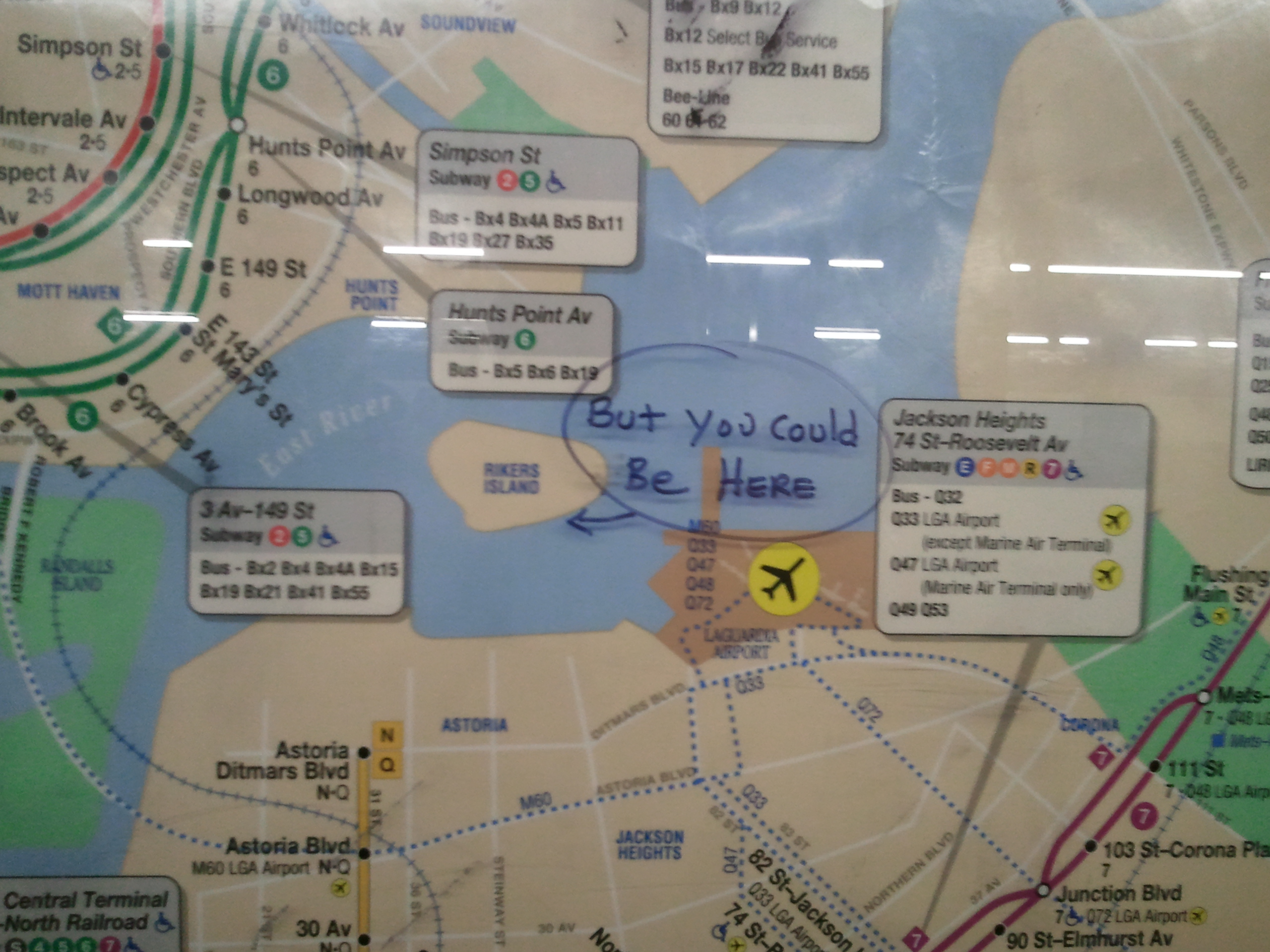
That New York is a city of writers goes without saying. But sometimes the words are unexpected: brief and witty as a haiku. From an outing in Lower Manhattan yesterday:

On a wall on Jersey Street, which is merely two blocks running from Crosby to Mulberry just south of Houston.
On a wall on Jersey Street, a nearly imperceptible street of merely two blocks running from Crosby to Mulberry just south of Houston.

Duly noted on the platform subway map at the F train at Second Avenue.
Duly noted on the platform subway map at the Second Avenue F stop.

What Jane Austen would have made of either of these, no one alive can say. But I am sure she would have enjoyed observing the Sunday-morning bagel-sandwich-buying scrum at Russ & Daughters, in its own way better than the Assembly Rooms at Bath.

The Darcy Perplex

Inspired by a need to understand the market, and my potential readers, I’ve recently embarked on a different kind of Jane Austen Project: reading more widely wildly a thing I’d been largely avoiding until now, out of fear it would either make it me give up in despair or unintentionally become a plagiarist: fiction inspired by Jane Austen.

So far, I am left with one overwhelming impression: astonishment at the iron hold that Mr. Darcy (specifically, as depicted by Colin Firth in the 1995 A&E film version) has left on the imagination of the producers, and, one can only suppose, the consumers of this kind of fiction. I’ve joked about the wet shirt scene

as much as anyone, but I shall do so no longer, for at a certain moment this notion stopped seeming funny to me, and become horrifying. Continue reading

Twitter Shakespeare

Today, being on Twitter finally paid for itself.

This might seem absurd, as being on Twitter has never cost me anything, at least in monetary terms. I could say it’s cost me something in agony, time and effort, but that wouldn’t be true; since I became a part of the Twitter landscape back in 2009, I have been among the lamest Twitterers going. The problem was I never quite understood what I was supposed to be doing on it; in theory I understood, but practice eluded me. Why would strangers be interested in my 140-character effusions on subject like “Clarissa”? And they weren’t. I wasn’t, even. Twitter was like a movie I’d walked into the middle of, a series of disconnected conversations at a party where I did not know anyone; nothing ever seemed to have any resolution.

If Twitter had a cost, it was measured out in bafflement.

Twitter would be completely dead to me if I did not get those e-mails suggesting people I might want to follow (but why?) or those containing the news that people were following me (even more so why?).

When I learn I have a new follower (I can’t count my followers on the fingers of one hand, but if I had a few more fingers I could), I have to wonder what strange creatures they might be. I read their tweets, their little self-descriptions and I check their Web sites. That was how I learned this morning that Pam Mingle, fond of what-ifs and gelato and books, author of a novel called “Kissing Shakespeare”, had become my follower. “Kissing Shakespeare,” I was intrigued to learn, involves time travel, Shakespeare and love.

Pam Mingle’s blog was exactly the sort of writer’s blog I like best: serious without being self-important, full of practical advice and intriguing links. But I could not focus on the blog yet. I had to know more about the book.

Here is someone who had wrestled with exactly the problems I have been facing. Like, how do you send a person into the past in a way that is not annoyingly improbable and doesn’t become all about the science fiction? What would the time traveler notice when they got there? What would they be disgusted by? What would they like? What sort of person would they need to be? How do you solve the existential problems time travel creates without making too little of them or, again, making it too much about the science fiction? What about her decision to make this a YA book? Was that a good idea? What did she gain and what did she give up with that?

I had to know more about this book. It was the work of but a moment to log onto my public library Web site, download “Kissing Shakespeare” onto to my Kindle and start reading. I’ve only read a few chapters, but I am fascinated. She’s nailed it, I think. More on this later.

This is exactly what I needed to have happen this morning. And I owe it all to Twitter.
‘In the Woods,’ ‘Broken Harbor’ and The Problem of Unreliable Narrators

I’ve been reading, actually listening to, “In the Woods,” the first in Tana French’s murder mystery series about a Dublin murder squad. I read the fourth in the series, “Broken Harbor,” first, because it got a lot of good notice. Both are narrated by a male detectives (not the same one) with, shall we say, issues, and aside from the usual guilty pleasures of a well-written and psychologically penetrating murder mystery, Ms. French in both books offers interesting perplexities about the nature of the first-person narrator who is unreliable, or at least has something to hide. Continue reading

Tides of War: Where the Magic Began

I generally start a novel with apprehension. Will it reward the time and effort I am expending on it? Will the things to like about it outweigh the imperfections? Will the ending disappoint?

And there is nearly always a moment, if  the magic works, when the novel achieves escape velocity and I know I am going to like it more than I fault it (even if the ending disappoints,  a separate problem). I don’t always notice when that moment comes, but in the case of “Tides of War” I did.  It was on Page 117, when Goya appears as a character, painting Wellington’s portrait and thinking his own thoughts. Continue reading

Tides of War: Will This Dog Hunt?

I’ve started “Tides of War” by Stella Tillyard, which I found lying around the office, a forlorn-looking review copy. (But the first forlorn-looking review copy I ever came across enriched with a glowing blurb from the awesome Simon Schama.)  “An epic novel about love and war, set in Regency England and Spain during the Peninsular War (1812-15) by the acclaimed historian and best-selling author of ‘Aristocrats.'” How could you not pick this up?

I’m on Page 106 of 368, and it seems worth it to say something about it now, while it is still alive and in flux in my mind. Continue reading