Inexplicably, I find myself reading “A Tale of Two Cities.” In tandem with “The First Five Pages: A Writer’s Guide to Staying Out of the Rejection Pile,” which I can’t help wishing Charles Dickens could have read, too. While he had no trouble staying out of the rejection pile, it still could have helped him. For I feel, once again, that the things that make Dickens so annoying are also what make him so unforgettable. Continue reading
Reviews and Asides

Hot Under the Fichu
The blogosphere has been all aflutter with the news that Clandestine Classics proposes to “spice up” the classics by adding erotic passages to works of literature including”Pride and Prejudice,” “Jane Eyre,” and oddly enough “20,000 Leagues Under the Sea.” (Actually, I’ve never read that; maybe there is a lot of suppressed erotic tension, though?)
How are we to understand this development? One thing to keep in mind is that Clandestine Classics gets no points for originality. One need only think of “Pride and Promiscuity: the Lost Sex Scenes of Jane Austen” or “Sense & Sensuality: Erotic Fantasies of Jane Austen,” to name but a few. The idea that sex is missing from Jane Austen (and Charlotte Bronte, etc) is apparently one people cannot get rid of, any more than they can stop themselves from rewriting “Pride and Prejudice” from Darcy’s point of view. But does it reveal any thing about the characters that we didn’t know already? I would tend to think not. If you cannot figure out just from reading “Persuasion” that Anne Elliot wants to have sex with Captain Wentworth, you are an idiot. Your library card should be revoked.
Another idea that occurred to me is there might be an untapped market for writing sex scenes into less likely 19th-century classics. “Middlemarch”? There’s a great well of repressed passion there. And the Rosamund-Lydgate marriage only makes sense if you understand it through the prism of sexual attraction. “Anna Karenina” would truly benefit from a little more in the way of heaving bosoms and warm loins. The reader is left to imagine that sex with Vronsky was amazing and this is why Anna K left her respectable life and son she loved very much to become a fallen woman — but Tolstoy never even gets to hint that. (He gets much closer to the bone in the deeply disturbing Kreuzter Sonata, which was promptly censored by the Russian authorities.)
“A Tale of Two Cities”? “Little Dorrit”??! The mind reels.
Share this:
Further Reading: Ivanhoe
Near the beginning of my current draft of “The Jane Austen Project” there is an allusion to “Ivanhoe.” As a matter of principle I have tried to read the books my characters read, and while I long doubted there was much to be gained from reading “Ivanhoe,” I downloaded the free Kindle version onto my phone anyway, just to have something to read in case I accidentally found myself on the subway between library books. This happened, and I started reading it.
I am perhaps a third of the way through, and it’s astonishing. Continue reading
Share this:
Further Reading: Second Impressions
Knowing little of the person but what I read in The New York Times, Sandy Lerner, as an idea, has long fascinated me, to the extent that she inspired a minor character in The Jane Austen Project, an ancient Ph.D. mathematician and tech billionaire with an obsession with literature, thought to be bankrolling the Jane Austen Project. When it turned out that Ms. Lerner (who for the record is neither ancient nor a Ph.D.) was giving a talk at my own local Jane Austen Society chapter, on a night that I already had off, no less, that I would be going to hear her was obvious.
I don’t know what I expected, except that it was certain to be interesting. It was that, and much more. Ms. Lerner, it turns out, has written a novel, having spent 26 years researching a historically accurate sequel to Pride and Prejudice. Continue reading
Share this:
Further Reading, Part II
Whose Jane Austen?
It’s a question I’ve often asked myself while researching and writing The Jane Austen Project, but never more insistently than when considering the works that make up the short story anthology “Jane Austen Made Me Do It, Original Stories Inspired by Literature’s Most Astute Observer of the Human Heart.” I use the subtitle advisedly, for this is one way of viewing Jane Austen, and perhaps a message from its editor, Laurel Ann Nattress of Austenprose, of how she, at least, does.
JAMMDI is on one hand a brilliant marketing idea, combining the brand recognition of Jane Austen with some of the biggest names in Austen and Austenesque fan fiction. But ideally it is more than that, being also an effort to wrestle with the question of what Jane Austen means to people living today, nearly 200 years after her death. Continue reading
Share this:
Further Reading: Jane Austen Made Me Do It, Part I
I have mixed feelings about much of the contemporary fiction inspired by Jane Austen, despite or perhaps because of my own efforts to write some myself. The work, and I include my own in this comment, often disappoints. Perhaps, like Marianne Dashwood, “I require so much!” Or perhaps the problem is inherent in inviting comparison with one of the wittiest writers to ever pick up a pen; one’s efforts can hardly avoid seeming pallid by contrast. It fails to be Jane Austen, as most everything does.
Despite the perils, people keep doing it, drawn like moths to a flame: writing sequels and prequels, imagining Jane Austen as a vampire, a sleuth or a con artist who fakes her death at age 41 and runs away, disguised as a man, to start a theater troupe, for which she writes all the plays, that tours the young nation of America. Actually, I made that last bit up. Nobody has written that book, which is not to say nobody ever will.
What makes them (us) do it? I suppose there are as many reasons as there are retellings of “Pride and Prejudice” through Mr. Darcy’s eyes: simple homage, awareness that there is an already created fan base, the same spirit of fun that impelled the teenage Jane Austen to mock the fictional conventions of the late 18th century. Then, too, there is the desire to fill in the unknown bits, and a large element of wish fulfillment. If reading a story is a way to indulge one’s fantasy of being or having what one is not or lacks in real life, then writing one is even more so.
And perhaps the strongest wish of all is to somehow be closer to Jane Austen, to connect with her spirit, her genius. The same spirit animating the women who sew their own Regency outfits and then model them on YouTube videos inspires others, more adept with a keyboard than with a needle, to write fan fiction. Jane Austen Made Me Do It! one can imagine them explaining with a shrug. Continue reading
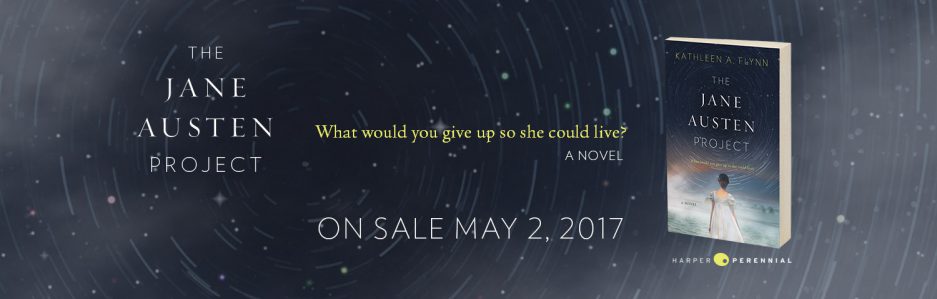
 The Jane Austen Project: A Novel