Further Reading: Jane Austen Made Me Do It, Part I

I have mixed feelings about much of the contemporary fiction inspired by Jane Austen, despite or perhaps because of my own efforts to write some myself. The work, and I include my own in this comment, often disappoints. Perhaps, like Marianne Dashwood, “I require so much!” Or perhaps the problem is inherent in inviting comparison with one of the wittiest writers to ever pick up a pen; one’s efforts can hardly avoid seeming pallid by contrast. It fails to be Jane Austen, as most everything does.

Despite the perils, people keep doing it, drawn like moths to a flame: writing sequels and prequels, imagining Jane Austen as a vampire, a sleuth or a con artist who fakes her death at age 41 and runs away, disguised as a man, to start a theater troupe, for which she writes all the plays, that tours the young nation of America. Actually, I made that last bit up. Nobody has written that book, which is not to say nobody ever will.

What makes them (us) do it? I suppose there are as many reasons as there are retellings of “Pride and Prejudice” through Mr. Darcy’s eyes: simple homage, awareness that there is an already created fan base, the same spirit of fun that impelled the teenage Jane Austen to mock the fictional conventions of the late 18th century. Then, too, there is the desire to fill in the unknown bits, and a large element of wish fulfillment. If reading a story is a way to indulge one’s fantasy of being or having what one is not or lacks in real life, then writing one is even more so.

And perhaps the strongest wish of all is to somehow be closer to Jane Austen, to connect with her spirit, her genius. The same spirit animating the women who sew their own Regency outfits and then model them on YouTube videos inspires others, more adept with a keyboard than with a needle, to write fan fiction. Jane Austen Made Me Do It! one can imagine them explaining with a shrug. Continue reading

The End!

You’ve got to get obsessed and stay obsessed.

— John Irving, The Hotel New Hampshire

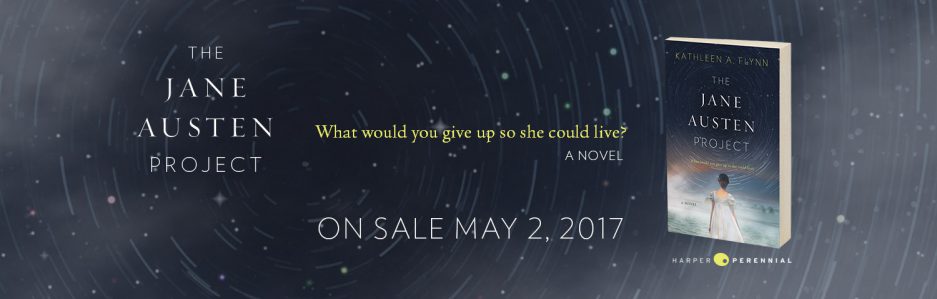
I think I finally see it. I thought I saw it before, so this might be a false positive, but I think I finally see what I have to do to get to the end. Yesterday I did something I have not done very often since I started The Jane Austen Project: I went back and read every chapter up to 26. (Chapter 27, as written, is dead to me. It is so clearly a mistake, in both incarnations, the original and the redo, that I could weep for all those lost hours I spent writing it, except there is no time for weeping.) I saw bright spots and missteps. I saw missed opportunities and strange passageways. I saw motifs. But the most important thing is, I saw it as a whole, something I have deliberately tried to largely avoid until now, for fear, I think, that there actually wouldn’t be a whole, that there would be nothing, out of all those words, that would really stick together to tell a story. But I need not have worried.

The end has to incorporate and resolve issues that were present from the start or that cropped up in the course of the story. Rachel and Liam have to do something they never expected in a million years that they would do, and it has to be completely believable. But also surprising, otherwise it is not fun.

They went for the letters, the ones Cassandra consigned to the flames before her own death in 1843. In the end, it is about the letters, and what they choose to do about them. About divided loyalties, past and future. Where do they, ultimately, belong? What is the right thing to do?

The End in Sight

I can see that the ending of “The Jane Austen Project” will take everything I have and then some. Everything I know about Rachel and Liam and their situation, and everything I know about Jane Austen. Everything in fact that I know about novels, and about life up to this point. But it is not primarily a matter of knowing; it comes from some deeper place than that.

And when I write a paragraph like that, and read it back over, I wonder: Am I making too much of this? Am I making it sound harder than it really is?

No.

I just read a magnificent ending. Indeed, the whole book was great. It fills me with joy to know that Jonathan Franzen is alive and among us, apparently in good health and capable of writing many more books like  Freedom. I began to fall in love with this book on Page 4, when he described his main female character, Patty, then in her early 20s and part of a newly gentrifying St. Paul neighborhood, in this way:

Tall, ponytailed, absurdly young, pushing a stroller past stripped cars and broken beer bottles and barfed-upon old snow, she might have been carrying all the hours of her days in the string bags that hung from her stroller. Behind her you could see the baby-encumbered preparations for a morning of baby-encumbered errands; ahead of her, an afternoon of public radio, the Silver Palate Cookbook, cloth diapers, drywall compound, and latex paint; and then Goodnight Moon, then zinfandel. She was already fully the thing that was starting to happen to the rest of the street.

It’s so amazing. Where do I start? The pitch-perfect detail, rich but just short of being over the top. The Silver Palate Cookbook. Public radio. Latex paint.  Zinfandel! The risk of locating a character so precisely, of course, is that readers of a future generation (and I have no doubt there will be such readers) will need footnotes. They will get it, but not entirely. But the real triumph is the move from the particular to the general to the universal. She was already fully the thing that was happening to the rest of the street. At this point, she might be just a stereotypical yuppie of a certain place and time; the point of view in this section, which is very cleverly done, seems to be a sort of Greek chorus of the neighbors, everyone and no one in particular,and to this narrator, Patty is clearly an enigma. As her mystery is revealed to the reader, slowly, over 562 pages, the stakes keep getting higher. For the characters, of course, but even more so for the writer. How to tie up a story with so many complex elements? How will he possibly resolve all this in a way that is both inevitable and surprising?

The good news is he does, magnificently. Reading this book gives me hope in endings, life, the future, and the future of the novel. And it gave me one important lesson: while it might be hard to write a good ending, it is not impossible.

In Which the Narrative Fights Back

It is nearly two months since I wrote the previous post. Where did the time go? Well, where does it ever go? Is that not the whole problem with life?

I suppose  that I should be excited. In the weeks since my last post I have had an experience I have often read about happening to other novelists and would-be novelists but never quite believed possible, when the characters revolted and refused to behave as they were told, instead rendering the narrative lifeless, stranding me in repeated blind alleys, until I relented and gave them what they wanted.

There was a character I meant to kill. I have intended all along, since I was first planning this novel in early 2008, to kill this character at the end of the book. The death had an important narrative function, or so I thought. It was supposed to be all about what we sacrifice for love and art. The death was supposed to make everything that happened after that, the tidy resolution of the various plot points, possible.

Except it didn’t work that way. Killing the character suddenly created a number of serious, seemingly unfixable problems. Worse, it suddenly halted the forward momentum of my narrative. As in real life, when someone important dies, everything stops, everything changes, and you are left gasping and paralyzed. How did I fail to realize that would happen?

I myself was devastated by the death of my character. It wasn’t supposed to work like this. They are, after all, fictional. How can I entertain such tender feelings for them? It seems the height of self-indulgence.

And I have to wonder, did Jane Austen have such problems?

Did she ever struggle, for example, over the question of whether Henry Crawford should come to his senses and not elope with Maria but persist in his love for Fanny? Actually, that is not a very good example. Did she ever think about having Willoboughy repent at the last minute and leave Sophy at the altar to reunite with his beloved Marianne, and marrying Elinor off to Colonel Brandon instead?

I have to think that she did not. And that is the difference between Jane Austen and me. She knew what she was doing. She never let the seams show. If she lived today and had a blog, it would probably be about needlework and fashion, but never about the struggles with her art.

On the other hand, thanks to the canceled Chapter 10, we do know that while she never doubted that Anne would end up with Captain Wentworth, there was some confusion in her mind about exactly how to make this happy event take place in a way that was dramatic and yet natural.

So maybe Jane Austen wasn’t perfect. I take only the most moderate comfort in this reflection, however.

I am still waiting for the other fabled thing that supposedly happens to novelists, when the characters rise up and push me to the finish line, when the force of the narrative propels me to the end, breathless but effortless. Yeah. I am waiting for that.

A Return to Mansfield Park

I felt I did not do full justice to Lynn Shepherd’s Murder at Mansfield Park the last time I wrote about it, and I resolved to go back and do something about that. I should have done so before now, but so many things have gotten in the way.

I wrote my comments at about midpoint in my first reading of the book, shortly before the murder is discovered. The book has 363 pages in the edition I am reading, and the body is discovered on page 158. Once a murder has been discovered, the book takes on a kind of energy it seemed to lack before that. Or maybe it is not the book that underwent a shift, but the reader.

For the things that were troubling me about the book up to that point — how it both was and was not like Mansfield Park, the abrupt shifts in points of view and tone, the moments of foreshadowing that did not seem to fit, my sense of puzzlement about what the author’s aim was — all seemed to fall away. Suddenly, everything made perfect sense, for I found myself in the familiar, forgiving world of an English country house murder mystery, and I understood exactly what the author was doing. And thought she did it very well. The detective, Charles Maddox, is perfect. Mary Crawford, once she steps out of the shadow of  the other Mary Crawford , becomes an engaging and sympathetic character. The mystery plot is taut and engrossing; the language never gets in the way.

And could I have not figured this out before? The title of the book, after all, contains the word “Murder.” There is an image of a corpse on the cover; a tasteful image, sure, but still; I was a bit slow on the uptake. The only thing I can say in my defense was, there was so much of Jane Austen here, I got confused. I was thinking the author was trying to do something else — what? I was not certain. Construct an alternate Mansfield Park, somewhat the way the wonderfully strange Wild Sargasso Sea constructs an alternate Jane Eyre? Certainly Mansfield Park is the novel that Jane Austen fans find the most vexing: the way the people we feel we are supposed to admire (Fanny and Edmund) are so much harder to like than the supposed villains of the piece (Mary and Henry Crawford). Certainly there is a large body of readers who think the main characters married the wrong people, and that a Henry-Fanny and Edmund-Mary match-up would have been a more satisfying result. I do not share these views, but I do understand them. Was this the author’s intent, to at once construct a homage to Mansfield Park and a more satisfying end to it, through the device of murder mysteries and alternate endings?

It’s a good deal easier, and probably more pleasing to readers, to write a good murder mystery than the Mansfield Park answer to Wide Sargasso Sea, and I am happy that this is what Lynn Shepherd did. The main lesson I took away from this book is how truly  elastic the murder mystery is as a form, despite its seemingly ironclad requirements.

SPOILER ALERT!!! And in this retelling, I really did think the heroine married the wrong person! I was hoping Mary Crawford would marry Mr. Maddox and travel around England solving crimes with him. I think this could be the basis for a very promising series. Perhaps in Lynn Shepherd’s next book, he can end up with another overlooked Austen heroine. Charlotte Collins, anyone (after the convenient death of her first husband)?

“Three Weissmanns of Westport” and “Murder at Mansfield Park”: On Austen Homage

To write any novel invoking the name or spirit of Jane Austen is to ask for trouble, by inviting unflattering comparisons with one of the greatest novelists of her age (or indeed of any age). Few can stand up to the comparison. The Jane Austen Book Club does. So, I am happy to report, does The Three Weissmanns of Westport, which  I started with apprehension and finished with steadily mounting delight.

The apprehension was at the notion of what Cathleen Schine had, according to the reviews, undertaken in this book: a modern retelling of Sense and Sensibility. How many ways are there to screw that up? Too many to count. But my delight grew as I kept reading, because there is a sense of joyful mystery in reading a novelist who is firing on all cylinders, writing at the height of her powers (actually, since this is the first book by Ms. Schine that I have read, I can’t really say that. Maybe her other books are even better, and I hope to determine that soon. The one about dogs looks especially promising. But it’s hard to imagine this particular book being any better than it was, and that is not something I think that often).

Why did it work so well? That was what I kept trying to figure out afterward, and it was kind of hard. Books that don’t work are often more instructive than those that do. With the successful ones, the seams don’t show. Also, novels that work seem to lull one into a happy stupor, putting the critical faculties to sleep, so later it is hard to be analytical.

First, it succeeds on a micro level because the writing, at the sentence and paragraph level, is good. By good, I mean, it does not draw attention itself by being either clumsy or excessively mannered.  The prose struck me initially as workmanlike, uncliched, a thing that is rarer than it should be. Then I began to gradually find the writing not just satisfactory, but actually rather lovely, though again in a nonshowy way. Also, funny. The humor sneaks up on the reader, not unlike Jane Austen’s in that that respect, though the jokes are quite different.

The book succeeds on more macro levels, too. The plot works because the author is not afraid to have nothing in particular happen for rather long periods of time; again, the mark of a writer who knows what she’s doing, who recognizes that plot is not just the piling on of incidents, but the reflection on what those incidents mean, the accretion of time changing the characters’ understanding of what is going on.  The plot, one might object, is stolen from Jane Austen; but that is not strictly true. What is so delightful about The Three Weissmans is how the author uses the skeleton of Sense and Sensibility but adapts it to her own story’s needs. The characters and situations are recognizable and yet transfigured — cleverly, but never simply to show off the author’s cleverness. They resonate with the spirit of Jane Austen, but they also offer a witty commentary on contemporary life. It is almost as if Sense and Sensibility and The Three Weissmans are nodding to each other across the chasm of the 200 years and the wide ocean that separates them: with understanding and compassion, but also with a smile. Because what it is, first and last, is funny.

Now I am reading Murder at Mansfield Park by Lynn Shepherd. I wanted to like this, but I am finding it hard going. I love Mansfield Park, and I love murder mysteries.  Ms. Shepherd has a Ph.D. in English literature from Oxford, and it shows. Her command of the vocabulary of the Austen era is pitch-perfect. She also scatters learned references throughout,  lifting entire sentences and paragraphs not just from  MP but from the other novels, as well as from  the letters and from Austen biography. “The heat keeps me in a continual state of inelegance,” one character remarks in a line  straight from a letter. “Indeed, she is quite the vainest, most affected, husband-hunting butterfly I have ever had the misfortune to encounter,” Mrs. Norris says of Mary Crawford, a remark in real life supposedly made about Jane Austen as a young woman by the mother of Mary Russell Mitford (though whether she actually knew her, or just later claimed to have, is open to some doubt).

The characters in Ms. Shepherd’s alternative Mansfield Park are jumbled like dice in a box. Most notably, Fanny Price, still a cousin of the Betrams, is now orphaned, fabulously rich, and insufferable. Mary Crawford is poor and worthy. Henry Crawford is a renovator of estates, rather like Repton. Julia Betram is sensitive and romantic and neglected, and vaguely like the two younger Dashwood sisters in Sense and Sensibility. Edmund, for some reason, is now the son and heir of Mrs. Norris, who is much like the original Mrs. Norris, except richer and more obnoxious; he seems to have cross-pollinated with Edward Ferrars from Sense and Sensbility. Everyone expects he and his cousin Fanny to marry and keep the wealth in the family. Maria Betram is rather like herself, and so is Tom Betram. Mr. Rushworth is still rich but no longer stupid.

I fancy I know Mansfield Park as well as the next person, having reread it only two months ago, but I find myself getting confused between the elements that overlap and those that don’t. In the first half of the book (as much as I’ve read so far) many of the same scenes and elements crop up — the trip to Sotherton, Lover’s Vows, the necklace, the ball, the game of Speculation, Sir Thomas Betram’s departure (he merely goes to Yorkshire, not Antigua), the departure of a beloved brother to sea (it’s Julia who pines for him, not Fanny).

Incident rapidly succeeds incident, but I can’t seem to answer the essential questions. Why has the author changed some things so utterly and left others the same? Where is she going with this? In theory it ought to be funny and ironic, winkingly postmodern, but for some reason I am not laughing. I think I am working too hard on figuring out what I am supposed to be paying attention to. It is undoubtedly a sincere homage. But why isn’t it working for me?