‘Less’ Is More Than the Sum of Its Parts

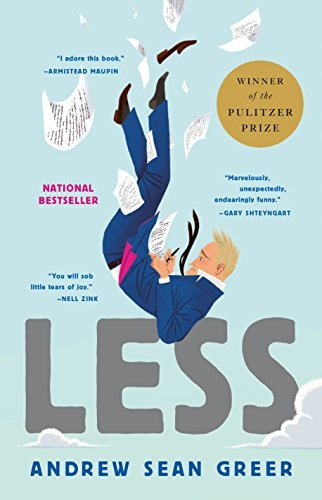
I “read” LESS as an audiobook, which may have affected how it worked on me. Though a short book, it took weeks to get through, chiefly because of all the limits when I allow myself to listen to an audiobook. (Mostly I listen in the gym — but then I got Covid and stopped going to the gym. On walks — but only when alone, because otherwise it’s antisocial. Not in bed at night, because I fall asleep and miss things. Not on my commute, because I am unreasonably afraid of an earbud falling out of my ear and into some irretrievable place. Etc.) So I kept putting it aside for days at a time and then returning to it, yet somehow never lost the thread. This might be in part because of its episodic nature, as I discuss more below.

LESS is laugh-out-loud-with-an-undignified-snort funny in places. (I had to suppress this impulse in the gym.) It is also lyrical. Andrew Sean Greer has a master touch with unexpected metaphors and similes, with descriptions that pierce your heart with their rightness. He writes well about love and longing and nostalgia. But anyone who writes about such topics, however well, risks descending into self-indulgent bathos, into sweet sentimentality. The humor is the lemon juice or the lemon zest that is supposed to keep this from happening. Did this work? Mostly, it did.

The structure is fairly simple, as the chapter headings make clear (Less at First, Less Mexican, etc). Arthur Less, in order to escape the wedding of the man he has (too late) realized he truly loved to another man, is traveling around the world courtesy of a series of decreasingly probable writerly events. (He’s a novelist, whose latest novel has been rejected by his publisher.) Everywhere he goes, disaster threatens but never quite strikes. It is not so much the rising action of a conventional novel as a picaresque — a series of episodes, rather than one thing leading to another. Although it is true that certain motifs recur, which does offer a sense of things being completed. The journey is mostly into himself, into the reality of getting older as a once-beautiful young man, facing age and time and the specter of death.

This book got a lot of prizes and acclaim and presumably sales. I always cheer when a book that dares to be funny instead of tragic manages that.

What’s Bred in the Bone: An Apology

Yesterday I found my review of WHAT’S BRED IN THE BONE had vanished from Goodreads. I immediately suspected it had been censored because of my choosing an impolite label for this book.

Today, though, it is back. I must therefore blame Goodreads’ squirrelly platform instead. But I am not sure. So I am posting what I wrote about this book, back in September 2023, because though it was not particularly brilliant, I want to remember what I said. Also, I think this book deserves to be better known.

Without further ado, I bring you WHAT’S BRED IN THE BONE by Allen Grant.

The first book in a long while that prompted me to add another tag (“batshit crazy”). I look forward to enlarging this shelf.

A friend recommended this book to me years ago; I downloaded it to my Kindle and forgot about it. In a dry spell of online book loans from the library, I happened across this one and decided to give it a try. So glad I did!

I will quote briefly from her blog (The Secret Victorianist) which sums it up better than I can hope to:

“If you’re after a novel with identical twin heroes who get toothache simultaneously, a heroine who struggles to overcome an overwhelming desire to dance with snakes (or feather boas), murder, illegitimacy and a rather morally dubious spell of diamond-hunting in South Africa, then this one’s definitely for you.”

How can a novel more than a century old, with so many ridiculous elements, be so much fun to read? I think it is the entertaining writing style, which keeps the absurd plot humming along.

The premise implied in the title, that genes powerfully affect character, is a potentially troubling and implicitly racist one, but this is never allowed to become an overwhelming theme — it just lingers in the background. A young women inherits a love of dancing with snakes from an (exotic, never made entirely clear exactly from where) ancestor, but in sturdy English fashion resists this, and triumphs over it. As one does. The natives of South Africa are depicted as savage, and some of the descriptions are cringe, yet it could be much worse for something written in this era. The author displays a certain sympathy for them that I was not expecting.

Small Things Like These: A Small Review

Twenty-four days into 2024, I’m renewing my resolution to post a brief review here of everything I read, instead of just posting on Goodreads.

Because, first, why should I work for Goodreads for free, when I can instead work for myself for free here on WordPress?

Second, my reviews seem to be vanishing off Goodreads. I definitely wrote down some thoughts about Grant Allen’s “What’s Bred in the Bone,” the most insane book I read in 2023, and now my review is gone! Vanished down the memory hole as if it never existed. I don’t think I had deep thoughts about it, but now I might as well now have had none. (Was it possibly the label “batshit crazy” that earned its erasure? I will never know. Goodreads does not explain. Goodreads does not apologize.)

But here, without further ado, Small Things Like These:

Wow. Holy mother of god. This book.

On my third book by her, I should be used to Claire Keegan by now and the things she can do with fiction, but “Small Things Like These” has knocked me sideways. It’s a very short novel and I listened to it on a weekend day. When it ended, I could not stop thinking about it.

Once I understood the basic problem that the story was setting forth, I could not imagine it how would end. But once I got to the end, I understood perfectly what would happen next. Like that of “Foster,” the ending “Small Things Like These” has a way of propelling the narrative, as if you as the reader are continuing the story in your head, participating in the work of the writer.

The problem the story sets forth is this: A man — Bill Furlong, a basically normal, decent man, with a personal history that has conditioned him to be sympathetic to outsiders and those down on their luck even though he himself, through hard work and self-discipline, has constructed a comfortable life — sees something he should not have seen, a vision of cruelty that causes him extreme discomfort.

Everything practical and sensible, every spoken and unspoken social pressure, is telling him to sweep it under the rug and pretend he never saw this thing. To ignore it would be the easiest thing in the world; no shame would attach, except that he attached by himself. And yet. And yet.

A universal story, you might say, and it is, but Keegan cleverly constructs it out of specific particulars, a carefully chosen time and place. It’s mid-1980s Ireland, a small town. It’s Christmastime, and it’s cold. We all know about the Magdalene laundries by now, but this is a few years before all the horrifying details would come out; the last years when small-town Ireland was effectively ruled by an informal yet powerful theocracy of the priests and nuns of the Catholic Church. Keegan makes it clear how people in the town sort of knew but sort of didn’t want to know what might or might not be going on in the convent, and how the women who worked there came to be there.

Furlong, whose business is supplying heating fuel like coal, wood and turf, goes to the convent to make a coal delivery, early on a Sunday morning because he’s so overbooked, not a time he would normally be expected. When he opens the coalshed door, he makes an unexpected discovery: a girl has been left there.

What’s so interesting and powerful about this book is the way it is rooted in particulars, yet it also has an almost mythic dimension. The way Furlong’s own childhood is something of a fairytale; minor characters who assume, ever so lightly, allegorical shapes. The use of snow, and cold, and Christmas. There is not one detail out of place, and even the evil nuns are sketched with a certain sympathy. For the Christians among us, it is one of those books that raises uncomfortable questions about what being a Christian actually means.

The Aspern Papers

My feelings about Henry James are mixed, and reading “The Aspern Papers” made me remember why. It’s everything I love about Henry James and everything that I can’t love about him, in one short book.

The story is fairly simple. A man — a writer, a critic, and devotee of a certain long-dead poet named Aspern — comes to suspect that a long-ago love interest of the long-dead poet (who died young), now very old and living in a small, isolated way in Venice, is in possession of papers that would change the face of Aspern scholarship. She has already forcefully rejected people who have reached out to her seeking said documents. So the narrator decides to try to become a boarder in her home, a much too large, decaying Venetian palace.

Rather to his surprise, this gambit works: for an outrageous rent, he’s in. Then nothing happens for a long time; the old lady is not very sociable, nor is her middle-aged niece, also living in the home. So he decides to try to win over the niece, and in this way somehow get to the aunt….

Read more: The Aspern Papers

Sometimes James really funny. But I often get the sense of being not quite in on the joke. His narrators are snobbish, pretentious, and often seem hardly to know themselves. It’s both fun and disconcerting, this sense of James the author peeking out, barely visible from behind the mask of the narrators that surely represent some aspects of the author himself — but which aspects? And how much?

He had to know himself pretty well to be able to write like he did, I think. And yet. There’s something he’s not saying. And when you get to the end of “The Aspern Papers,” it’s pretty clear, at least to the modern reader, what this something is.

The longer James went on writing, the less readable I find him. (I loved “Portrait of a Lady” but I confess to giving up on both “The Golden Bowl” and “The Wings of the Dove” because I could not find my way through the morass of the words enough to understand what was happening. And probably to some people, that means I have forfeited all rights to have any opinions about James, at least any well-informed ones) “The Aspern Papers” is still relatively early Henry James, though, and the story hums along nicely, not too bogged down by sentences one gets lost in. The atmosphere of Venice more than a century ago is wonderfully rendered, and it’s fun to imagine that beautiful city before mass tourism made it into a ghost of itself.

What happens with the aunt, the niece and the papers is both comic and tragic, both inevitable and surprising. Is it as obvious to everyone else as it seemed to me that James was gay (as he did not feel free to be open about, unsurprisingly) and spent much of his fiction trying NOT to write about this fact?

Not that I mean, heaven forfend, to reduce him to his sexual preference, or to try to suggest that this explains everything about his writing in general, or “The Aspern Papers” in particular. People are complicated; Henry James certainly was!

It’s just, once you see this, you cannot unsee it.

Having read “My Search for Warren Harding” not much earlier definitely enhanced my appreciation of “The Aspern Papers”; the two novels are in dialogue with each other in such an interesting way that I think people should always be encouraged to read them together.

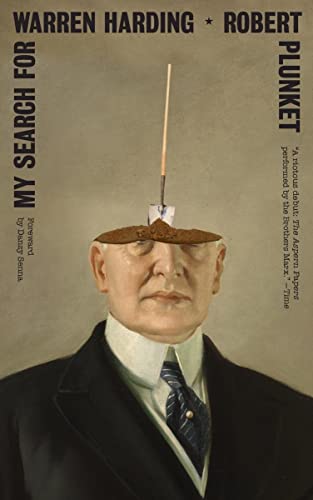
My Search for Warren Harding

Book Cover

I learned about My Search for Warren Harding from a story in The New York Times. It was originally published in the 1970s and soon fell into obscurity, along with its author, though becoming sometimes of a cult classic for its edgy humor. By chance a few years ago it fell into the hands of people influential enough to get it published again and given a second chance at fame. Even better: Robert Plunket, in his 80s, is still alive and gets to enjoy his book’s revival.

His new introduction had me laughing out loud, so I had high hopes for the actual book. Alas, these were only partly realized, though there are definitely funny moments.

The other introduction, by the writer who helped get republished, essentially warns the reader: Political incorrectness ahead! There is a great deal of homophobia and fat-shaming here, which would get Mr. Plunket canceled had he dared to write it today, and perhaps was funnier a few decades ago. But one should read a book as a reflection of its time, not impose today’s strictures on it.

But to get to the story. It is narrated in the first person by an obscure historian who has come to California from New York City in hopes of obtaining a cache of documents connected to President Warren Harding, who notoriously fathered a child with his mistress. The narrator has discovered through a series of unlikely events that this love child is in fact still alive, though obviously quite old, and living in Southern California. She is still in possession of these papers. Certain they will change the field of Warren Harding studies forever, as well as make his career, he engages in an escalating set of bad choices in an effort to get his hands on them.

So the plot itself is kind of a nonsense quest; it reminded me of Headlong by Michael Frayn. Just as that book taught the reader about Bruegel’s paintings between the madcap capers, this one painlessly teaches the reader more about Warren Harding. (And who among us does not need to learn more about Warren Harding?) In sheer wackiness, it reminded me of Made for Love by Alissa Nutting.

The story kind of sputters along, or so it seemed to me — though delightfully. Reading it was like having the sort of friend who tries to tell you a story of something that happened to them but keeps getting sidetracked by humorous asides. Until finally you give up and realize that the humorous asides are in fact the point.

The real interest here is in the narrator. He has the stereotypical reactions of a New Yorker to Southern California, and he is — as becomes increasingly clear as the story goes on — a deeply closeted gay man. There is humor in this but honestly for me also pathos, which I don’t think the writer was necessarily intending (although who can know for sure).

In one of the introductions, or maybe The New York Times story, I learned that this is a rewrite of The Aspern Papers, a book I have long meant to read by another famously deeply closeted gay man. Maybe this will finally get me to do it.

Hello Again

I’ve been sadly neglecting this blog, but have resolved to revive it, if only to keep track of my reading. The things that I write on Goodreads (an increasingly squirrelly platform; and has anyone else noticed it is giving inaccurate dates for when a book was read?) will now also go here, starting today, on the 206th anniversary of the way-too-early death of Jane Austen (even though she is, for practical purposes, immortal).

Starting with my most recent read, The Sparrow by Mary Doria Russell (a great author name, very nice balance of syllables).

Read more: Hello Again

THE SPARROW is a novel written in the 1990s and set partly in 2014-2019 and partly about 40 years later, telling the story of a mission to another planet led by Jesuits.

Which sounds like the setup of a joke but isn’t. And why not Jesuits, I suppose? They are known for bringing the word of Jesus everywhere.

Which does raise the question of whether, if there are other planets in the universe with sentient life (the odds for it seem good when you consider just how big the universe is), what kind of gods do they have? Can the Jesuits really argue that Jesus came to Earth to rescue humanity from original sin, but you guys on Planet X ought to worship him too, because….

Or should we suppose that Jesus, taking as our Jesuit starting point the notion that Jesus literally existed/exists, also came to Planet X, in some form or another? Such questions tax my weak theological muscles, so I would probably be better off talking about the novel.

The earlier timeline tells the story of how the mission came to be: a radio telescope has picked up a transmission from a distant planet that consists of beautiful and haunting music. A group of people — among them, an astronomer, a physician, an engineer and a Jesuit priest — who are all friends become fascinated by this and somehow find themselves involved in a secret Jesuit-sponsored mission to the planet.

The other timeline is 40 years later, when the sole survivor of that mission, the priest, returns to Earth, physically and mentally shattered. (Although not actually 40 years older, because, relativity) The party that came and rescued him found him in a shocking and lurid situation (details of which are revealed only gradually) and the job of a group of priests in the later timeline is to figure out what happened. To get him to confess, basically, so he can cleanse his soul.

As the priest, Emilio Sanchez, gradually and reluctantly tells his story, the other timeline also advances and the two eventually converge.

What I liked about this book: the alien planet is very interestingly imagined. At a few points, the omniscient narrator allows us into the mind of one particular resident of the planet who will play an important role in the story, and I found this fascinating and persuasive. We also learn a little about the alien language the visitors pick up and how the language shapes how they see the world. The parts set on Earth also feel solidly detailed and imaginatively realistic, if that makes sense. I also thought the conceit of the novel was so wacky yet intriguing that I could not help but keep reading to see how it would be resolved.

What I struggled with: the pacing is a little odd. It takes a long time to get going, though the setup is mostly enjoyable. But the mysteries so intriguingly introduced get resolved at the end in what felt to me like a rush, and they are not narrated directly but instead are told at a remove. Also, the characters are introduced in the start, sometimes at great length, and then we don’t seem to learn much more about them as we go along. They spend entirely too much time for my taste bantering with each other; the author insists a bit too much on how incredible and clever they all are.

But I admired the author’s willingness to go there — to address questions of faith and doubt in a way that was earnest and searching, even at the expense of seeming unsophisticated or basic. Even though I am not a religious person, these are interesting questions. Even though I wasn’t entirely satisfied with the way they are resolved here. And it was somehow fascinating to see a writer in the 1990s imagining the time we live in now.

This book also made me happy by reminding me of another book about a Christian mission to an alien planet, which I remember loving though I have forgotten many plot details: The Book of Strange New Things by Michel Faber.