Rereading Middlemarch in 2025

What I’m struck by this time around is something that’s easy to miss 150 years later: George Eliot was writing historical fiction. Published (in installments) in 1871 and 1872, the chief action of the book takes place over the end of the 1820s and start of the 1830s. It would today be like writing a novel about the mid-Reagan years, by someone born in the 1970s — old enough to remember those times. (Eliot was born in 1819 and died in 1880.)

I too am old enough to remember the 1980s. It is a real time for me, not something from history books, and I see the images of those days in color — not the sepia tones of the 19th century or the black-and-white of the early 20th century. Yet it was also a long time ago, and a lot has happened since. A person setting out now to write a novel of the 1980s would have to carefully think about the telling details. Corded landlines (though in those days known simply as “phones”). Cassette tapes. Guess jeans. Madonna. Morrissey. Those masses of rubber jelly bracelets people wore — why? “Falcon Crest” on the TV. Gorbachev. Last days of the Iron Curtain, though no one knew it yet. Such a novelist would need to think about how much the world had changed in the intervening 40 years, and how people in the 1980s had little idea what was coming, yet were obliged to go through their lives, making their moral and career and marriage choices with the best information available at the time.

It’s this kind of doubleness that 50-something Eliot would have had in her head sitting down to write Middlemarch, and that she could expect her readers to be aware of.

From the vantage point of 2025, both 1871 and 1830 seem equally long ago. For modern readers, she might as well have written this in 1835. But they are wrong. The 1830s had at least as much tumult and change as the 1980s, and perhaps more. It took the perspective of decades to take in what it all meant.

And once you see, you can’t unsee it. How Eliot makes a point of noting the absurdity of women’s bonnets, or observing that someone is wearing a pelisse, or talking about the Reform Bill or labor unrest, or surveying land for where the railroad will come through. Old-fashioned ideas about medical science. To me it seems all flavored with nostalgia for a lost world, the world of her own childhood, and with the awareness of how much change the years would bring.

It’s an even wider canvas, then, than we normally think of Middlemarch as being. Not just a whole town, and the country gentry who live outside the town. Not just a series of happy and unhappy marriages and struggles with money and careers, but the action of time itself.

‘Less’ Is More Than the Sum of Its Parts

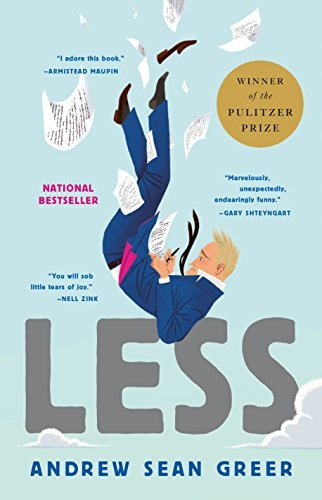
I “read” LESS as an audiobook, which may have affected how it worked on me. Though a short book, it took weeks to get through, chiefly because of all the limits when I allow myself to listen to an audiobook. (Mostly I listen in the gym — but then I got Covid and stopped going to the gym. On walks — but only when alone, because otherwise it’s antisocial. Not in bed at night, because I fall asleep and miss things. Not on my commute, because I am unreasonably afraid of an earbud falling out of my ear and into some irretrievable place. Etc.) So I kept putting it aside for days at a time and then returning to it, yet somehow never lost the thread. This might be in part because of its episodic nature, as I discuss more below.

LESS is laugh-out-loud-with-an-undignified-snort funny in places. (I had to suppress this impulse in the gym.) It is also lyrical. Andrew Sean Greer has a master touch with unexpected metaphors and similes, with descriptions that pierce your heart with their rightness. He writes well about love and longing and nostalgia. But anyone who writes about such topics, however well, risks descending into self-indulgent bathos, into sweet sentimentality. The humor is the lemon juice or the lemon zest that is supposed to keep this from happening. Did this work? Mostly, it did.

The structure is fairly simple, as the chapter headings make clear (Less at First, Less Mexican, etc). Arthur Less, in order to escape the wedding of the man he has (too late) realized he truly loved to another man, is traveling around the world courtesy of a series of decreasingly probable writerly events. (He’s a novelist, whose latest novel has been rejected by his publisher.) Everywhere he goes, disaster threatens but never quite strikes. It is not so much the rising action of a conventional novel as a picaresque — a series of episodes, rather than one thing leading to another. Although it is true that certain motifs recur, which does offer a sense of things being completed. The journey is mostly into himself, into the reality of getting older as a once-beautiful young man, facing age and time and the specter of death.

This book got a lot of prizes and acclaim and presumably sales. I always cheer when a book that dares to be funny instead of tragic manages that.

The Blog’s Gone Dark

I have not posted here since an outing in February to a wonderful dramatization of the Bronte sisters’ life. I am not keeping up with my reading list  (although I do  so on Goodreads). I started another #100daysofwriting challenge and quickly began forgetting — not to write, I never forget that — but to take a daily picture and post it on Instagram.

Feckless though I am, it struck me it might be fun in retrospect to have had some record here of the progress of the novel I imagine myself to be writing. Though it may come to nothing (the novel-diary plan, I mean — the novel will come to something, though hard to say what), mere risk of failure is not enough of an argument against. So here goes, in hopes that it can encourage others as much as myself.

I got a half-baked notion to write about the Brontes back in 2013, though I did not form any resolve until 2017,  also an alarmingly long time ago. Continue reading

Rabbit or Writer: On Authenticity

220px-the_velveteen_rabbit_pg_1

I have an agent. I wrote a novel that sold to a Big 5 publisher. I  belong to two writing critique groups, and I live in Brooklyn. Yet when one of my newer writing critique group members asked me if I’d been to any residencies — not in a judging way, but in a friendly, encouraging tone — I froze, as if this were a trick question; a veiled insult; a failure of tact. But only people like you go to those, I thought but could not say. Real writers. Not only have I not gone to one; it would never occur to me to apply! Not that I wouldn’t want to —  just like I’d like to go horse trekking in Mongolia. Equally dreamy, equally improbable.

But later I started to think over this exchange, and to wonder. What would it take for me, like the Velveteen Rabbit, to become real? What does it take for anyone? Continue reading

‘Longbourn’ and Pig Shit Realism


Longbourn

All the time I was reading Jo Baker’s “Longbourn” I had the sensation of not being able to decide if I liked it.  This is unusual;  feckless and tentative as I am in most realms of human activity, I am generally confident in my literary judgments.

The story, in case anyone  missed the large splash it made upon publication in 2014, is “Pride and Prejudice” from the viewpoint of the Bennets’ servants. A brilliant, can’t-miss idea. I like to imagine Ms. Baker, tormented by insomnia and casting around for her next idea for a novel, sitting up in bed.

HOLY SHIT! I’LL CALL IT ‘LONGBOURN!’ Continue reading

New Beginnings, Old Problems

I’ve been away from this blog for so long I feel almost obliged to fashion some adroit explanation — picnic, lightning — but the truth is, I was doing other things. Reading, writing, rethinking, rewriting. (When does rewriting have an end? I can only say, not yet.)

After “The Golem and the Jinni” I proceeded to read a string of amazing books I wish I had stopped to write about, for now I cannot do justice to them: Continue reading